
KDOC Release and Discharge Paths
The Kansas Department of Corrections is a statewide prison and supervision system. It is not a detention facility in McPherson County. A person convicted in the county may first leave McPherson County Jail through a recorded commitment or transfer to KDOC, then be assigned to a state institution elsewhere. That county departure is not community release. KASPER becomes the proper public record after state intake.
Leaving a KDOC institution does not always end the sentence. Parole, conditional release, and postrelease supervision place a person outside prison while KDOC authority continues. A discharge status means the state corrections sentence and its supervision obligation have ended. Community Corrections is a probation-related category, not another name for state-prison release. Deceased or discharged-deceased is not a community release, and absconder is a supervision-status lead rather than proof of current incarceration.
| KASPER status | Meaning for release |
|---|---|
| Inmate | Institutional KDOC custody continues |
| Parole or postrelease | Prison custody ended, but state supervision remains |
| Conditional release | Statutory release for an eligible sentence with KDOC authority continuing |
| Discharged | The KDOC sentence obligation has ended |
| Absconder | Reported loss of supervision contact; not proof of present jail custody |
Search KDOC McPherson Records
KASPER, the Kansas Adult Supervised Population Electronic Repository, covers people sentenced to the Secretary of Corrections since 1980 who are incarcerated, under post-incarceration supervision, or discharged. It is not a complete history of every Kansas corrections contact. Interstate-compact inmates sent into Kansas can be excluded, and some community-corrections data is limited during system modernization.
- Open the KASPER disclaimer and accept it to reach the search form.
- Search by KDOC number when available. It is safer than a name-only match.
- Otherwise enter the first and last name, then use middle name, alias, or birth information carefully to narrow the result.
- Select McPherson as conviction county only when the underlying conviction arose there. A current location need not be in McPherson.
- Open the detail and compare KDOC number, case, conviction county, descriptors, and movement dates before treating it as the same person.
- Read supervision type, current and movement locations, parole office, and date fields together.
The McPherson County release search explains when to return to sheriff and court sources. KASPER does not cover a person who simply posted bond, completed a local jail term, or had a county charge dismissed without a KDOC commitment.
KDOC Records and Contact
Public offender information begins with KASPER. Accuracy concerns may be sent to KDOC's public-information email, while sentence-calculation questions have a separate telephone line. For records not shown in the free repository, KDOC accepts Kansas Open Records Act requests through its tracked GovQA portal. No local prison contact belongs here because the research identified no KDOC institution in McPherson County.
Kansas Department of Corrections
Statewide corrections and supervision system
Public information: kdoc_pub@ks.gov
Sentence computation: 785-296-3317
Public records: KDOC GovQA portal
KASPER updates: normally each working day, excluding weekends
McPherson parole and postrelease cases may be assigned to the Salina Parole Office at 919 E. Prescott, Suite 300, Salina, KS 67401, telephone 785-827-2584. Assignment can change, so use the parole-office field in the current KASPER detail and verify it with KDOC. Probation through McPherson Court Services or Harvey/McPherson Community Corrections is a separate local path.
KDOC Is Not a Local Prison
The McPherson County facility map includes KDOC as a system destination because state facilities can hold people convicted in McPherson. It does not claim that a state prison sits within the county. A county jail serves arrest, pretrial, and local custody functions. KDOC holds and supervises people committed to the Kansas Secretary of Corrections under state sentences. Their assigned institution may be far from the conviction court.
A sheriff release entry can therefore show the point when county custody ended and KDOC custody began. KASPER then follows the state episode through institutional placements, movement dates, noninstitutional supervision, and discharge. Treating the two records as one event would erase a major custody transition. The conviction county is also not proof of current residence, prison location, or parole-office assignment.
- Parole
- Conditional community release used mainly for eligible indeterminate or older-law sentences.
- Postrelease supervision
- Mandatory community supervision that follows many determinate prison terms.
- Discharge
- The end of the KDOC sentence obligation, including required supervision.
- Anticipated release date
- KDOC's estimate of a future date, subject to change.
- Movement
- A recorded change in institutional or supervision location.
Read KDOC Release Fields Together
KDOC's locating material lists the name and KDOC number, physical descriptors and photograph, convictions, county, case number, anticipated release date, current and prior movement locations and dates, parole-office location, custody or supervision level, and disciplinary findings. Search filters can include exact or alias name, KDOC or KBI number, birth information, conviction county, supervision county, facility, and supervision type.
No single field should be read alone. A past anticipated date paired with an inmate status does not prove release. Credits, discipline, court action, sentence recalculation, a detainer, or data timing may have changed the estimate. A parole or postrelease status plus a movement away from an institution supports prison departure, while discharge is the stronger indication that KDOC authority has fully ended.
The official KDOC locating explanation illustrates the coverage and date terminology.

The image helps identify the statewide source and its anticipated-date language. Always recheck the live record because working-day updates and later movements can change the current answer.
Request KDOC Discharge Records
When the public KASPER detail leaves a material gap, use the KDOC GovQA portal. Ask for existing public release, discharge, and movement records for the named person. Include the KDOC number and relevant case information. Starting with the free KASPER record helps identify the exact field or period needed and avoids asking staff to recreate information already available.
A useful request distinguishes release from prison from final sentence discharge. Ask for the recorded movement out of institutional custody, the supervision status and effective date, later discharge date if applicable, and the public sentence or movement record supporting those fields. Do not ask KDOC to prepare a new explanation. Request native electronic copies where available and an itemized cost estimate before the agency incurs fees above a chosen limit.
K.S.A. 22-3711 protects presentence, preparole, pre-postrelease, and supervision-history reports. Redaction or withholding of privileged details may be lawful even when basic status, sentence, date, and movement data is public. K.S.A. 45-219 permits reasonable actual copy, staff, review, and redaction costs and may allow advance payment.
The official portal shows the state channel used to submit and track a request.
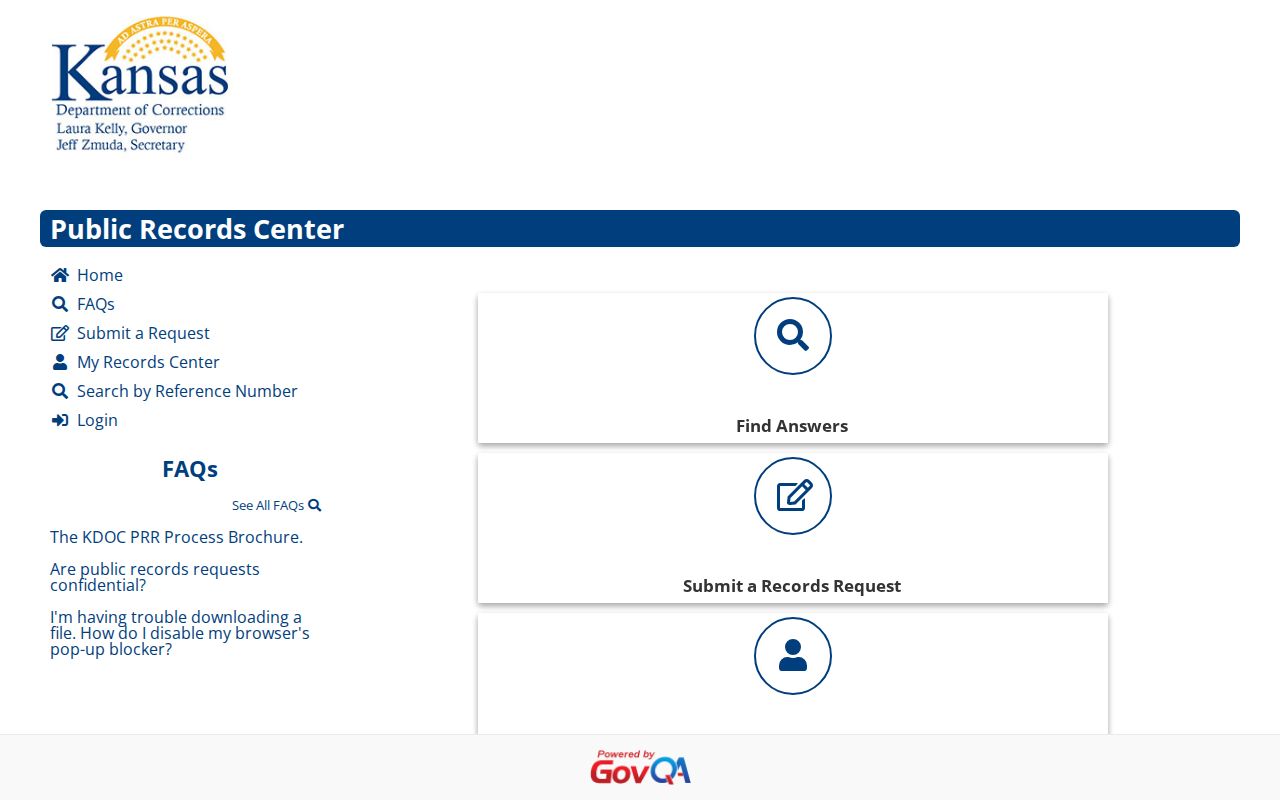
A tracked request is most effective when it names the person, KDOC number, record type, and date range instead of seeking every file held by the department.
KDOC Anticipated Release Dates
KDOC uses the exact label “Anticipated release date.” It is a computed estimate, not an observed departure. Kansas does not apply one universal percentage to every prison sentence. Good-time limits depend on the offense date, type, and severity, while some qualifying sentences may receive program credit. Credits may be earned, withheld, lost, or affected by conduct and release planning.
For many determinate sentences, good time changes the split between imprisonment and mandatory postrelease supervision rather than ending the full sentence obligation. Indeterminate sentences use different parole and conditional-release concepts. Off-grid terms, mandatory minimums, and other special sentences require their own analysis. A parole eligibility date or board action also does not prove that physical release occurred.
Confirm an actual KDOC release through current supervision status and movement data, not an anticipated date by itself.
If an anticipated date has passed while KASPER still says inmate, preserve the access date, recheck the movement record, and contact the Sentence Computation Unit. Do not replace KDOC's current status with a personal calculation.
McPherson KDOC Supervision After Release
A KASPER result showing parole, conditional release, or postrelease means the person is outside a prison but still under KDOC authority. The record may identify the parole office. McPherson cases can involve KDOC's Salina office, though the county of conviction alone does not prove where someone lives or reports. Ask KDOC to confirm the office assignment when that information is public.
Local probation must be kept separate. McPherson Court Services handles probation and bond supervision. Harvey/McPherson Community Corrections administers more intensive grant-funded probation programs. Those court-based placements are not the same as release from a KDOC prison. The order, KASPER status, and named supervising office determine the correct channel.
An absconder entry means KDOC reports a loss of supervision contact or unresolved status under its rules. It does not prove that the person is now jailed, and the record may have changed after the last working-day update. Confirm with KDOC and do not attempt independent enforcement or confrontation.
Resolve Holds After KDOC Release
Departure from a Kansas prison does not prove that every other custody matter ended. A person may face another state case, county warrant, federal sentence, or immigration hold. KASPER establishes the KDOC portion. The receiving agency's record must establish what followed. A movement into another authority's custody is a transfer even when KDOC describes its own custody as ended.
Use the Bureau of Prisons locator only for federal prison custody. A past federal release date with location “RELEASED” means the person is no longer in BOP custody, but it does not establish the end of federal supervised release. USMS federal pretrial custody has no public person locator. ICE's online locator covers current custody and some recent releases within its limits. None of these sources replaces KASPER for the Kansas state sentence.
Identity remains critical across systems. Compare KDOC number for the state record, booking number for county custody, federal register number for BOP, and A-number for ICE. Dates and middle names help, but unnecessary personal details should not be republished.